Beloveds, it is good to be here. Will you pray with me?
Covenant-making God, we give thanks for this time together, for the gift of holy words, and holy truth. Make this preaching moment a sacred time, infusing it with your Spirit, that through your Word, we might remember the way you would have us go, and follow.
May the words of my mouth, and the meditations of all our hearts be acceptable in your sight, O Lord, our Rock and our Redeemer. Amen.
Several years ago, I was on sabbatical with my daughter, and we spent a few weeks exploring the sights of London together. One of the great joys of that time was the freedom to explore, to find our own way. Unlike many of the museums here in the United States, the great museums of that city were free; we could visit over and over again, without price. By virtue of proximity, we were able to stop into our favorites for an hour or two in the course of a day’s activity, without worrying about how much the visit would cost.
We got to know each other’s ways quite well. Our tastes in art do not generally coordinate. I could wander stained glass galleries for days. I enjoy old illuminated manuscripts, and textiles. It was mostly the Victoria and Albert Museum that had my heart. My daughter – nearly sixteen at the time – had a thing for the Tate Modern.
It’s hard to miss: this art gallery on the south bank of the river Thames, by Shakespeare’s Globe Theatre, across the Millennium Bridge from St. Paul’s, a bustling location packed with people, day or evening. Housed in a redesigned power station, with an observation deck and a soaring tower, it’s been called an industrial cathedral. On top of the building, there’s a lighted sign that announces in capital letters: ART CHANGES WE CHANGE.
Sunday, February 25, 2018


Sunday, August 20, 2017
Confession (Anastasia)
God, there are times we act
As if we belong only to ourselves,
Forgetting who we are, and whose we are.
Forgive us for the times
We have used others for our own ends,
Directing them toward our preferred path,
Rather than seeking to discern with them
Which path will lead them towards you.
Forgive us for the times
We have come to believe
That there is no hope.
Help us find the melody of holiness
That will make our souls dance again;
The notes which will remind us of
what we almost lost.
Keep us grounded in your heart.
Call us back to one another.
Call us back to you.
Amen.
Prayer of Confession,
God on Broadway Series:
Anastasia
As if we belong only to ourselves,
Forgetting who we are, and whose we are.
Forgive us for the times
We have used others for our own ends,
Directing them toward our preferred path,
Rather than seeking to discern with them
Which path will lead them towards you.
Forgive us for the times
We have come to believe
That there is no hope.
Help us find the melody of holiness
That will make our souls dance again;
The notes which will remind us of
what we almost lost.
Keep us grounded in your heart.
Call us back to one another.
Call us back to you.
Amen.
Prayer of Confession,
God on Broadway Series:
Anastasia
Saturday, July 08, 2017
Confession (Dear Evan Hansen)
Loving God,
You who see us more clearly
Than we ever see you,
We confess the stories we make up
to pad the empty places of our lives,
the false images we create in word and picture
To buffer our true selves
from our neighbors, from pain,
and sometimes even from you.
These lies are
no more comfortable
than the truth.
They hurt, too, God.
Forgive the avalanche of words and actions
that serve no good purpose at all.
Forgive all the ways in which we fall down;
And knit our broken pieces back together. Amen.
Prayer of Confession,
God on Broadway Series:
Dear Evan Hansen
You who see us more clearly
Than we ever see you,
We confess the stories we make up
to pad the empty places of our lives,
the false images we create in word and picture
To buffer our true selves
from our neighbors, from pain,
and sometimes even from you.
These lies are
no more comfortable
than the truth.
They hurt, too, God.
Forgive the avalanche of words and actions
that serve no good purpose at all.
Forgive all the ways in which we fall down;
And knit our broken pieces back together. Amen.
Prayer of Confession,
God on Broadway Series:
Dear Evan Hansen
Sunday, June 04, 2017
Confession (Lion King)
Holy One–
Mighty, Tender, and Challenging,
We must confess that we sometimes get lost.
We lose the sound of your voice within us,
The powerful truth that you spoke before time began,
And we feel as if we are going it alone.
Sometimes the world seems to laugh.
The powers threaten to devour us.
The night and the scope of our problems
Make us feel tiny and friendless.
We are tired, ashamed, vulnerable.
Forgive us for what we have done, and left undone.
Reach within us and give us hope and courage.
Set our spirits aflame.
Remind us of who, and whose we are:
We are your children. We cannot do this alone.
We need you. In Christ's name we pray. Amen.
Prayer of Confession:
God on Broadway Series
The Lion King (Pentecost Sunday)
Mighty, Tender, and Challenging,
We must confess that we sometimes get lost.
We lose the sound of your voice within us,
The powerful truth that you spoke before time began,
And we feel as if we are going it alone.
Sometimes the world seems to laugh.
The powers threaten to devour us.
The night and the scope of our problems
Make us feel tiny and friendless.
We are tired, ashamed, vulnerable.
Forgive us for what we have done, and left undone.
Reach within us and give us hope and courage.
Set our spirits aflame.
Remind us of who, and whose we are:
We are your children. We cannot do this alone.
We need you. In Christ's name we pray. Amen.
Prayer of Confession:
God on Broadway Series
The Lion King (Pentecost Sunday)
Sunday, February 26, 2017
The Meeting Place (A Transfiguration Sermon)
Did you see the trees yesterday? My social media feeds were filled, for a time, with photos and glad remarks from friends who stopped what they were doing and took note. The afternoon sun passing through ice-encased twigs was perhaps the best after-effect of Friday night’s weather. Driving along a country road on Saturday was like driving through a jewelbox, all glittering crystal. I thought it looked like a hymn. My daughter and I debated how you might paint such a marvel. These curves and branches - the shapes had seemed so dull and ordinary, late-February drab fading into the background just a few days before. Yesterday? Glorious.
This is transfiguration: that which surrounds us everyday, elevated, made more beautiful. For a while, holy imagination reigns and we can see the glory.
And then we round the curve into town, and pull into the garage, and somehow it’s all still there waiting for us. There is still homework to be done, a sermon to be finished, dinner to be sorted out, and the cats have an opinion about the state of their litterbox.
There are the times when your holy imagination is filled with sunsets and mountains, crystalline trees and freshly-washed baby, hope and newness and the glory of God. The stuff of life, transfigured. Flesh, milk, water, bark, sunshine, photosynthesis, DNA, …which coexist with diapers, spitup, sweat, dirty litterboxes and the desperate need for sleep.
Jesus took his closest followers up the mountain to pray, and Luke tells us they were so gosh darn tired they were ready to drop. There are the times when human limitations tell holy imagination to stuff it. Aching muscles, tired of paying attention, do we have to do this now?
Yes, now. Even though we are tired, and smelly and messy, just ordinary human beings. He wants to do this now. Right now is the time for glory to meet our footsore, fumbling attempts to follow.
This is transfiguration: that which surrounds us everyday, elevated, made more beautiful. For a while, holy imagination reigns and we can see the glory.
And then we round the curve into town, and pull into the garage, and somehow it’s all still there waiting for us. There is still homework to be done, a sermon to be finished, dinner to be sorted out, and the cats have an opinion about the state of their litterbox.
There are the times when your holy imagination is filled with sunsets and mountains, crystalline trees and freshly-washed baby, hope and newness and the glory of God. The stuff of life, transfigured. Flesh, milk, water, bark, sunshine, photosynthesis, DNA, …which coexist with diapers, spitup, sweat, dirty litterboxes and the desperate need for sleep.
Jesus took his closest followers up the mountain to pray, and Luke tells us they were so gosh darn tired they were ready to drop. There are the times when human limitations tell holy imagination to stuff it. Aching muscles, tired of paying attention, do we have to do this now?
Yes, now. Even though we are tired, and smelly and messy, just ordinary human beings. He wants to do this now. Right now is the time for glory to meet our footsore, fumbling attempts to follow.
Sunday, November 20, 2016
Revised and Expansive: A sermon on the Reign of Christ
What’s a preacher to do when the scripture for the day – several weeks in a row - cuts a little too close to what’s going on in the world? The same thing one does any other Sunday: preach the text. Preach the Gospel. We are people of faith. And if we shy away from our sacred stories because they bear an uncomfortable word, then we are no better than the king who fed a scroll bearing forty years’ worth of prophetic words into the flames.
This is the Word the Spirit has brought to the church this day: a perilous time, when the nation is under threat. The Prophet Jeremiah under house arrest, confined, prevented from gathering with God’s people. God’s word snatched from Baruch’s hand - and in a section we skipped over for length today - God’s prophets had to go into hiding. The scroll with these holy, subversive words taken to the palace and read in private quarters amid the king’s closest advisers, and then deliberately, section by section, consigned to the fire. Burned because the king did not like what he was hearing. Because he wanted to suppress the message being spread by the prophet.
What we have in today’s scripture is tantamount to a book burning. We’re not talking about a single speech here. We are talking about a scroll containing forty years of Jeremiah’s life’s work - his heart and soul, everything God had given him for the good of the nation of Israel, the shining days and the terrible days and everything in between. A masterwork, destroyed.
It would be easy, after such a disaster, to give up. It would be natural — particularly for Jeremiah, who was already prone to depression, and lived in difficult times — to give in to the inner voice of doom. To stand there in judgment, shaking one’s head, saying, “I told you so.” Worse: to entertain fantasies of revenge, as if salvation is to be found there. But the prophet doesn’t give up, although it would have been so easy to do so. Instead, he stayed rooted in his call, offering us a model of faithful resistance to a world that just wants to get back to normal when it’s everything but business as usual:
First, the prophet speaks the word given by God.
Over and over again, the prophet spoke the words. Sometimes it offended people. But he kept going. Then, the prophet passes the word on to others, so they are equipped to share it. When Jeremiah couldn’t go himself, Jeremiah taught Baruch. Baruch wrote it down so it could be shared. And Baruch spoke it in the temple. And then - I love this part - when the powers of this world try to shut down the transmission of God’s word (because when does that ever work, people?) - the prophet steps up again. This is when God germinates the seeds of the Word that are planted in the weary heart of the prophet, and it cracks wide open again. You may think you have seen it all and done it all and by all that is holy you are tired, but the word of the Lord comes to you and here it comes again:
“Write down all the words that were in the first scroll that was burned.”
Write down all of the words...and more. The scroll was burned. The powerful ones shut it down. Has the message been lost? No. Just delayed. Write the revised and expanded edition, God says.[1]
They're not going to like hearing this one any better, but it’s still worth saying. Justice is justice. Write it. Speak it. Send My Word forth, instructs God — so the prophet continues to raise the uncomfortable questions before the nation as a whole, not neglecting to confront the powerful, not neglecting to speak in the public square:
And do you allow room, in your economic life for rest, as God commanded?[6]
And to whom do you give supremacy?
Today is Reign of Christ Sunday, when we remember who rules supreme. When we remember the kingdom - or kindom - to which we belong. We are in the middle of a challenging time in the life of our nation, and a challenging run of texts from the Hebrew Prophets, to be followed by a challenging run of texts about the imminent arrival of Jesus, Emmanuel, God-With-Us. We may come to church looking for comfort. But the comfort in the Gospel is inseparable from its challenge, inseparable from Christ’s claim upon our lives.
Our Christian life leads from font, to table, to cross: We baptized a baby last week, and set her on the road to discipleship. Remember all the things we said about the water: water is washing, and soothing, and slaking thirst, and drowning. It is death and it is life. Remember all the things we say at the communion table: it is a meal, where we nourish our bodies, where we celebrate the great banquet where none are excluded, where there is always enough, and it is also a funeral meal, where we remember that it is a gift offered to those Christ already knows will abandon him before he dies. Even the first resurrection story is filled with challenge, more than comfort.
King Jehoiakim wants to enjoy his comfortable winter chambers by the firepit. The nation would like it very much if things could get back to normal. It’s a lovely dream; but that’s all “normal” ever was, a dream. Because “comfort” was only comfortable for some, and “peace” only “peace” for some. To abandon them for our own comfort is to abandon the Gospel.
Prophets, attend! We have been given a Word for our time. Though there may be those in our nation who say, "Hush! Your Word disturbs our peace," and urge us to quiet ourselves, we are called to proclaim it again, more boldly. For here is the way our God works: never settling for a retread of the past, but going beyond, calling us to speak and work for the revised, expansive vision of human community, a community ruled according to kindness, justice, and righteousness.
Amen.
[1] Jeremiah 36:32 [2] Jeremiah 7:5-6 [3] Jeremiah 9:10 [4] Jeremiah 5:28 [5] Jeremiah 8:10-11
[6] Jeremiah 17:19-24 [7] Jeremiah 10:10 [8] Jeremiah 10:12 [9] Jeremiah 6:16 [10] Jeremiah 9:24
Text: Jeremiah 36:1-8, 21-23, 27-38 then 31:31-34. Preached at McFarland UCC
This is the Word the Spirit has brought to the church this day: a perilous time, when the nation is under threat. The Prophet Jeremiah under house arrest, confined, prevented from gathering with God’s people. God’s word snatched from Baruch’s hand - and in a section we skipped over for length today - God’s prophets had to go into hiding. The scroll with these holy, subversive words taken to the palace and read in private quarters amid the king’s closest advisers, and then deliberately, section by section, consigned to the fire. Burned because the king did not like what he was hearing. Because he wanted to suppress the message being spread by the prophet.
What we have in today’s scripture is tantamount to a book burning. We’re not talking about a single speech here. We are talking about a scroll containing forty years of Jeremiah’s life’s work - his heart and soul, everything God had given him for the good of the nation of Israel, the shining days and the terrible days and everything in between. A masterwork, destroyed.
It would be easy, after such a disaster, to give up. It would be natural — particularly for Jeremiah, who was already prone to depression, and lived in difficult times — to give in to the inner voice of doom. To stand there in judgment, shaking one’s head, saying, “I told you so.” Worse: to entertain fantasies of revenge, as if salvation is to be found there. But the prophet doesn’t give up, although it would have been so easy to do so. Instead, he stayed rooted in his call, offering us a model of faithful resistance to a world that just wants to get back to normal when it’s everything but business as usual:
First, the prophet speaks the word given by God.
Over and over again, the prophet spoke the words. Sometimes it offended people. But he kept going. Then, the prophet passes the word on to others, so they are equipped to share it. When Jeremiah couldn’t go himself, Jeremiah taught Baruch. Baruch wrote it down so it could be shared. And Baruch spoke it in the temple. And then - I love this part - when the powers of this world try to shut down the transmission of God’s word (because when does that ever work, people?) - the prophet steps up again. This is when God germinates the seeds of the Word that are planted in the weary heart of the prophet, and it cracks wide open again. You may think you have seen it all and done it all and by all that is holy you are tired, but the word of the Lord comes to you and here it comes again:
“Write down all the words that were in the first scroll that was burned.”
Write down all of the words...and more. The scroll was burned. The powerful ones shut it down. Has the message been lost? No. Just delayed. Write the revised and expanded edition, God says.[1]
They're not going to like hearing this one any better, but it’s still worth saying. Justice is justice. Write it. Speak it. Send My Word forth, instructs God — so the prophet continues to raise the uncomfortable questions before the nation as a whole, not neglecting to confront the powerful, not neglecting to speak in the public square:
And are you caring for God’s creation?Do you treat each other justly? Do you follow the Lord’s ways? Stop taking advantage of the immigrant, orphan, or widow. Stop shedding the blood of the innocent,… going after other gods to your own ruin…[2]
Are the rich and powerful growing fat and sleek, prospering, indifferent to the plight of the orphan, the rights of the poor?[4]“I will weep and wail for the mountains, and lament for the grazing lands in the wilderness. They are dried up and deserted; no sound of the flocks is heard; no sign of birds or animals is seen; all have vanished.”[3]
Do you treat the worker with justice?From the least to the greatest, all are eager to profit. From prophet to priest, all trade in falsehood. they treat the wound of my people as if were nothing: “All is well, all is well,” they insist, when in fact nothing is well.”[5]
And do you allow room, in your economic life for rest, as God commanded?[6]
And to whom do you give supremacy?
“The Lord is the true God! He’s the living God and the everlasting King!”[7]
“God made the earth by his might; he shaped the world by his wisdom, crafted the skies by his knowledge.”[8]
It is words such as these the prophet carried to the nation, which had him banned from the temple, confined, his words burned, and eventually killed in exile. It is words such as these which Jesus used to confront the powers of his time, words that got him killed.“Stop at the crossroads and look around; ask for the ancient paths. Where is the good way? Then walk in it.”[9]
Today is Reign of Christ Sunday, when we remember who rules supreme. When we remember the kingdom - or kindom - to which we belong. We are in the middle of a challenging time in the life of our nation, and a challenging run of texts from the Hebrew Prophets, to be followed by a challenging run of texts about the imminent arrival of Jesus, Emmanuel, God-With-Us. We may come to church looking for comfort. But the comfort in the Gospel is inseparable from its challenge, inseparable from Christ’s claim upon our lives.
Our Christian life leads from font, to table, to cross: We baptized a baby last week, and set her on the road to discipleship. Remember all the things we said about the water: water is washing, and soothing, and slaking thirst, and drowning. It is death and it is life. Remember all the things we say at the communion table: it is a meal, where we nourish our bodies, where we celebrate the great banquet where none are excluded, where there is always enough, and it is also a funeral meal, where we remember that it is a gift offered to those Christ already knows will abandon him before he dies. Even the first resurrection story is filled with challenge, more than comfort.
King Jehoiakim wants to enjoy his comfortable winter chambers by the firepit. The nation would like it very much if things could get back to normal. It’s a lovely dream; but that’s all “normal” ever was, a dream. Because “comfort” was only comfortable for some, and “peace” only “peace” for some. To abandon them for our own comfort is to abandon the Gospel.
Prophets, attend! We have been given a Word for our time. Though there may be those in our nation who say, "Hush! Your Word disturbs our peace," and urge us to quiet ourselves, we are called to proclaim it again, more boldly. For here is the way our God works: never settling for a retread of the past, but going beyond, calling us to speak and work for the revised, expansive vision of human community, a community ruled according to kindness, justice, and righteousness.
God is writing the revised and expansive edition. It’s gonna take a while. There’s still time to get involved. Prophets, are you in?“I am the Lord who acts with kindness, justice, and righteousness in the world, and I delight in these things, declares the Lord.”[10]
Amen.
[1] Jeremiah 36:32 [2] Jeremiah 7:5-6 [3] Jeremiah 9:10 [4] Jeremiah 5:28 [5] Jeremiah 8:10-11
[6] Jeremiah 17:19-24 [7] Jeremiah 10:10 [8] Jeremiah 10:12 [9] Jeremiah 6:16 [10] Jeremiah 9:24
Text: Jeremiah 36:1-8, 21-23, 27-38 then 31:31-34. Preached at McFarland UCC
Sunday, October 16, 2016
The Power of Memory
How many things do you think we forget in a day? The answers from the professionals range from 4 specific tasks or items - along the lines of charging our phones, picking up the milk or where we placed our keys - to 99% of what we observe to the very scientific answer "a lot."
The continued existence of the Western way of life in our time demands a sort of amnesia[1]. To go about daily life in the way of the average North American suburbanite is to forget -- and so we must be very skilled in the art of forgetting. It is necessary, when I go to the mall, that I must forget about the many pairs of shoes gracing the back of my bedroom door. At the grocery store, faced with aisle after aisle of options, it is necessary that you forget about the lettuce growing limp, the cheese moldering in a drawer in your refrigerator, the person who has one can or none in their cupboard, not ten cans or freezer or fresh to choose from.
The economy's health demands that you forget the person who may or may not be working this Sabbath day to stitch the sweater you will be buying on Black Friday. It is necessary, for the sake of the economy, or empire (pick your E word, they may be one and the same), to forget the first inhabitants of the land over which this newest oil pipeline is intended to run, and its current inhabitants, for that matter.
I remember a little girl who could not go to sleep one night because she was sad about the polar bears, whom she had just learned were losing their habitat due to the melting of the polar ice cap. Truth be told, I had forgotten, and I found myself disconcerted, until I managed to forget again.
We must forget, on a daily basis, the polar bear and the Great Barrier Reef, or we would fail to buy our next car, or take our next business trip, or perhaps offer a prayer of confession with too much earnestness.
"Come, let us forget together," says the voice of Empire. "Let us be at ease together. Go to sleep. Do not think overmuch about past or future."
Forgetting has its gifts; it seems to hold the world's hurt at bay for a while. There are so many hurts that if we were to hold them all tenderly we would be leaving trails of tears all over the sidewalk. The Empire's offer sounds like a reasonable compromise toward daily survival.
So we accept the invitation to live in today, and when fear of tomorrow, or pain of yesterday intrudes, we cushion it with more sensory input, more work, more stuff -- embedding ourselves ever more deeply in the trappings of empire.
This forgetting business is the root of all sorts of brokenness. Contrary to its promise to make things easier, it causes dis-ease. Forgetting steals something of our humanity. It is a spiritual sickness, separating us from God, from creation, from neighbor.
If forgetting is the disease, what is the best remedy? Remembering.
My AP history teacher had a banner printed over his classroom blackboard: those who fail to remember the past are condemned to repeat it. Remembering is good for more than passing a history test or becoming a Jeopardy champion. Remembering, if done properly, is an act of resistance.
In school we do a lot of intellectual remembering - using our brains; remembering from the neck up. This is good, and worthy - and incomplete.
God gave us so much more than our brains. Remembering done properly frees the whole body to remember. We remember with our sense of smell; the scientists tell us that's the sense most closely linked with our memory centers. We remember with our muscles. Muscle memory (athletes? musicians?) comes from hours of practice, somehow knowing the “how” of doing something without even needing to consciously think about it.
Building those patterns is important so we can draw on them in urgently needed moments, when we’re under stress. This is why we are a community of faith, not solitary practitioners. This is why we gather to worship, not try to follow the way of Christ on our own.
Our worship is a practice of freedom – an act of remembering together; an act of resistance against a world that actively urges us to forget. More and more often, we are getting out of our heads and remembering with our whole selves in worship. We are singing freedom in so many musical languages - in traditional hymn, and jazz, and acapella spiritual and African rhythm. That music sometimes inspires our bodies get into the game, and ALLELUIA, freedom is coming - the Holy Spirit is in the house.
Freedom is profoundly unsettling. Worship to equip us for leaving is going to have to rattle the foundations of empire. It might have rattle us, too.
One lesson this thorny passage from Exodus is teaching us is that God knows we are good at forgetting. Even before freeing the people from captivity God sets out instructions for remembering this crucial saving act. God knows we will need it to get us through trouble time and time again.
It's not like we encounter only one Pharaoh throughout all of history. The Empire shows up with different names, in different disguises. It's not like George Lucas came up with Star Wars from nothing! There’s Pharaoh in Egypt, and Nebuchadnezzar in Babylon, Rome under the Caesars, colonial powers of Europe carving up Asia, Africa and the Americas...Hitler's Germany and Mussolini's Italy. Our own country, the United States of America, has had Pharaohs and been Empire. There are places we are doing it now, and we are always at risk of doing it again. There are Pharaohs in our workplaces. You may have survived a Pharaoh in your home, in a personal relationship. Their presence may be uncomfortably close. You may be staring down a drug-or-alcohol or food-based Pharaoh.
They all say the same thing: forget. Forget who and whose you are. You belong to me. Let me decide for you. And for every cry of every one of God’s children facing any Pharaoh, God proclaims FREEDOM with a voice to shatter the night. God says, REMEMBER. You are my child. I will not abandon you.
The instructions for the Passover observance tell the people of God it is not just a good thing, but imperative to remember. Not just with our HEADS but with our whole beings: Body, attitude. Community.
In the face of these domineering Pharaohs, our solitary brains are not gonna be enough to remember with, folks. This is going to have to be a whole-body, whole-community remembering.
Remember what the Lord did for you, when he brought you up out of Egypt? We need to be able to both SAY it and DO it for one another. With one another. Get ready to move, Moses said, God is about to do something big. Put your shoes on. Act as if this is an urgent business.
Remember? You are MY people. I will lead you up and out of this place. Remember this day, body and soul. Remember what I am doing. This is who I am. In the night of chaos and crying I will be with you. You are marked for freedom. You are mine.
Remember.
[1] NIB 787
Preached October 16, 2016 at McFarland UCC. Text, excerpts from Exodus 12 and 13.
The continued existence of the Western way of life in our time demands a sort of amnesia[1]. To go about daily life in the way of the average North American suburbanite is to forget -- and so we must be very skilled in the art of forgetting. It is necessary, when I go to the mall, that I must forget about the many pairs of shoes gracing the back of my bedroom door. At the grocery store, faced with aisle after aisle of options, it is necessary that you forget about the lettuce growing limp, the cheese moldering in a drawer in your refrigerator, the person who has one can or none in their cupboard, not ten cans or freezer or fresh to choose from.
The economy's health demands that you forget the person who may or may not be working this Sabbath day to stitch the sweater you will be buying on Black Friday. It is necessary, for the sake of the economy, or empire (pick your E word, they may be one and the same), to forget the first inhabitants of the land over which this newest oil pipeline is intended to run, and its current inhabitants, for that matter.
I remember a little girl who could not go to sleep one night because she was sad about the polar bears, whom she had just learned were losing their habitat due to the melting of the polar ice cap. Truth be told, I had forgotten, and I found myself disconcerted, until I managed to forget again.
We must forget, on a daily basis, the polar bear and the Great Barrier Reef, or we would fail to buy our next car, or take our next business trip, or perhaps offer a prayer of confession with too much earnestness.
"Come, let us forget together," says the voice of Empire. "Let us be at ease together. Go to sleep. Do not think overmuch about past or future."
Forgetting has its gifts; it seems to hold the world's hurt at bay for a while. There are so many hurts that if we were to hold them all tenderly we would be leaving trails of tears all over the sidewalk. The Empire's offer sounds like a reasonable compromise toward daily survival.
So we accept the invitation to live in today, and when fear of tomorrow, or pain of yesterday intrudes, we cushion it with more sensory input, more work, more stuff -- embedding ourselves ever more deeply in the trappings of empire.
This forgetting business is the root of all sorts of brokenness. Contrary to its promise to make things easier, it causes dis-ease. Forgetting steals something of our humanity. It is a spiritual sickness, separating us from God, from creation, from neighbor.
If forgetting is the disease, what is the best remedy? Remembering.
My AP history teacher had a banner printed over his classroom blackboard: those who fail to remember the past are condemned to repeat it. Remembering is good for more than passing a history test or becoming a Jeopardy champion. Remembering, if done properly, is an act of resistance.
In school we do a lot of intellectual remembering - using our brains; remembering from the neck up. This is good, and worthy - and incomplete.
God gave us so much more than our brains. Remembering done properly frees the whole body to remember. We remember with our sense of smell; the scientists tell us that's the sense most closely linked with our memory centers. We remember with our muscles. Muscle memory (athletes? musicians?) comes from hours of practice, somehow knowing the “how” of doing something without even needing to consciously think about it.
Building those patterns is important so we can draw on them in urgently needed moments, when we’re under stress. This is why we are a community of faith, not solitary practitioners. This is why we gather to worship, not try to follow the way of Christ on our own.
Our worship is a practice of freedom – an act of remembering together; an act of resistance against a world that actively urges us to forget. More and more often, we are getting out of our heads and remembering with our whole selves in worship. We are singing freedom in so many musical languages - in traditional hymn, and jazz, and acapella spiritual and African rhythm. That music sometimes inspires our bodies get into the game, and ALLELUIA, freedom is coming - the Holy Spirit is in the house.
Freedom is profoundly unsettling. Worship to equip us for leaving is going to have to rattle the foundations of empire. It might have rattle us, too.
One lesson this thorny passage from Exodus is teaching us is that God knows we are good at forgetting. Even before freeing the people from captivity God sets out instructions for remembering this crucial saving act. God knows we will need it to get us through trouble time and time again.
It's not like we encounter only one Pharaoh throughout all of history. The Empire shows up with different names, in different disguises. It's not like George Lucas came up with Star Wars from nothing! There’s Pharaoh in Egypt, and Nebuchadnezzar in Babylon, Rome under the Caesars, colonial powers of Europe carving up Asia, Africa and the Americas...Hitler's Germany and Mussolini's Italy. Our own country, the United States of America, has had Pharaohs and been Empire. There are places we are doing it now, and we are always at risk of doing it again. There are Pharaohs in our workplaces. You may have survived a Pharaoh in your home, in a personal relationship. Their presence may be uncomfortably close. You may be staring down a drug-or-alcohol or food-based Pharaoh.
They all say the same thing: forget. Forget who and whose you are. You belong to me. Let me decide for you. And for every cry of every one of God’s children facing any Pharaoh, God proclaims FREEDOM with a voice to shatter the night. God says, REMEMBER. You are my child. I will not abandon you.
The instructions for the Passover observance tell the people of God it is not just a good thing, but imperative to remember. Not just with our HEADS but with our whole beings: Body, attitude. Community.
In the face of these domineering Pharaohs, our solitary brains are not gonna be enough to remember with, folks. This is going to have to be a whole-body, whole-community remembering.
Remember what the Lord did for you, when he brought you up out of Egypt? We need to be able to both SAY it and DO it for one another. With one another. Get ready to move, Moses said, God is about to do something big. Put your shoes on. Act as if this is an urgent business.
Remember? You are MY people. I will lead you up and out of this place. Remember this day, body and soul. Remember what I am doing. This is who I am. In the night of chaos and crying I will be with you. You are marked for freedom. You are mine.
Remember.
[1] NIB 787
Preached October 16, 2016 at McFarland UCC. Text, excerpts from Exodus 12 and 13.
Sunday, September 25, 2016
In the Middle of It All
Look at all this beauty! “You may eat freely,” God said - consume freely, take it all in, make it a part of you -
So you accept this gift of unguardedness, wandering freely. You open your heart to receive the world, using the fullness of your senses; feel the warmth of the sun on the back of your neck, say thank you for the blessed choice of the mosquito to take her meal elsewhere; enjoy the taste of water when you scoop it to your mouth, know the particular scents of the morning and evening, hear another creature’s movements somewhere in the garden, your soul enlarging with each particle of creation -
And then your eye settles on the tree. You remember the word, “except.”
It’s all yours, except for that one tree.
A curious word, except. Here we are, so close to the beginning of Creation, and there is already an “in” and an “out” group, what’s ok and what’s not. “In” and “out” makes the possibilities feel a little more limited.
In the fertile land, the story says, God grew every beautiful tree with edible fruit, and also the tree of life in the middle of the garden and the tree of the knowledge of good and evil.
Go about your business. Enjoy the expansiveness of God’s garden. Delight in the diversity of creation. Wander freely and let your senses absorb the richness which surrounds you. Care for all of it. Eat your fill, except – see that one, there, right in the middle of everything? Eat from that one, and it’ll kill you. Have a nice day. Enjoy your freedom. Try not to think about the tree.
Except.
That not-insignificant limit might have been easier to take if the tree were at the edge of the garden instead of right.there.in.the.middle.of.everything. If it took a day trip to get out to the tree; if you had to go out of your way to see it, a bit of thoughtful tourism perhaps, a diversion. Somewhere in the corner, or on one of the side paths you didn’t travel every day, where you could credibly pretend it didn’t exist, now and then, instead of constantly catching glimpses when you were vulnerable and unprepared to deal with it.
Sunday, October 04, 2015
Another Damn Sermon on Gun Violence

We just had our nine hundred and eighty sixth mass shooting since Sandy Hook. That was in 2012, in case you’re keeping count. Two hundred and seventy four days into this year, there have been two hundred and ninety four mass shootings. The satirical news site, The Onion, has taken to simply reposting the same article each time a shooting happens, with updated locations and dates.
I was chatting with a good friend this week and said that I didn’t want to preach one more damn sermon about gun violence. She suggested, why don’t you just say that, bluntly. I replied, "I did. Four gun violence sermons ago." Dear ones, I am tired of this sermon. As (I’m sure) are you. As (I’m sure) is God.
I came home yesterday from presiding at a memorial service, and sat down to begin writing this sermon which I don’t want to be delivering. Naturally, my gift for procrastination took hold. I decided I would turn to my news feed to read a bit of what others were saying; it doesn’t do to compose a sermon while uninformed. At which point, I learned that our military forces – the United States’ – had bombed a hospital run by the international charity Doctors Without Borders. A hospital serving victims in a war zone in Afghanistan, with coordinates made known to both sides.
Words fail.
“Deliver us!,” the people cry out on Facebook, on Twitter, in the coffee shops and cafes. “Deliver us!,” they cry out under their breath while driving to work and hearing the latest death toll. "Deliver us!" while huddled in the corner of a classroom with the lights off. “Deliver us!,” the people cry out as they hug their children to bed at night. “Deliver us,” with the lighting of candles, the sharing of articles and saying of prayers.
While the politicians say, too, “Deliver us!” Deliver us into office. Deliver us into the halls of power, and then beyond, to the halls where the lobbyists and campaign contributors wield their greater power with a higher paycheck and higher stakes.
We stand in the presence of the Holy One. Lead us not into temptation, but deliver us from evil. Deliver us from the temptation to despair. Lead us into prayerful action.
We have been caught up in a repetitive loop of lament, captive to endless news coverage and a dystopian vision that the odds are so overwhelming there is no realistic path to change. It is as if we were still living in the days of the Romans, when the crucified lined the roads as a warning to those who dared challenge the might of an empire. Understand that every death in every mass shooting, every proclamation that nothing can be done, is another cross raised to keep you living in terror. This is all those news stories are designed to achieve: keep the way of death foremost in our hearts.
Is this the way Christ calls us to live? Enslaved, captivated by the power of death? We belong to a different story. The apostle Paul says this of Christians: We do not grieve as others do, who have no hope. We believe there is an end to the cycle of sin and death.
I am the God of the ancestors. I hear the cries of distress. I am aware of the suffering. Now go...for I am sending you to do something about it.
The burning bush is where we are called out. God knows who we are, and how we are tempted to slide back into our comfortable lives of sheep-herding and goat-tending. But at the burning bush, when people are dying and God calls you to act, prayer and refuge in personal holiness are not an acceptable retreat. God knows that Moses is far from perfect. He is a murderer and a coward, and not a very good public speaker, either. There are a multitude of excuses to be offered, but none are sufficient to disqualify him.
With every stammer of Moses, God repeats, “I Am; I Will Be.” And it is there we find our answer. Remember God’s name: I AM. God’s name is existence itself, a declaration of life. Do you really think a God like that will give any ground to the power of death?
If you have seen the flames and know the name of the one who calls you, if you admit this ground is holy, then you have no refuge in excuses. Yours is the voice God will use.
Such is the power of naming.
Followers of Christ’s way: the road does not end with death on a Holy Friday, or with lament on an empty Saturday. The road doesn’t even end with a glorious Sunday on which Resurrection is proclaimed. The road doesn’t end.
One of the earliest names for Christians was “followers of the way.” We are disciples – students; and apostles – messengers. If we are serious about our Christianity, then we proclaim life in the face of death; abundance in the face of scarcity, freedom in the face of enslaving powers that would oppress and impoverish God’s children. We allow ourselves to be broken open and poured out for the sake of the world. We do this, not under our own power, but rooted in the power of the one who sends us. We are given God’s name that we might use it in times of need.
If we believe in these things, then we pray without ceasing, and write without ceasing, and walk and speak without ceasing. We stand alongside the grieving, bearing witness to the temporary dominion of death, and we confront the powerful, demanding to know why human life is being sacrificed for financial gain.
We say to the ones who walk in the halls of power, enough with these damn sermons about gun violence. Deliver us from your excuses and your platitudes. There are solutions and we demand them.
Moses, you have been called to action by a voice from a burning bush. There is nothing about this which will be comfortable.
So make politicians uncomfortable. Moses had to do a lot of badgering of Pharaoh to become more than a joke to the political elite. Show up at campaign rallies and media events and office hours and ask how many people have to die before these policymakers take action.
If we are serious about this Christian thing, maybe we become single issue voters. Refuse to vote for a politician who will not take a stand on this, and let them know. Shift investments away from funds which support the machinery of death -- the guns and the bombs and the drones. Begin the de-funding of war, both domestic and foreign.
If we are serious about this Jesus thing, we bring these issues up in polite conversation. Don’t be timid. Make sure everyone knows your feelings: bring it up with your card club, your book club, your coffee klatsch, your curling and hunting and football-watching buddies. You do not know how many opinions you may sway.
We have been given the name, Christian. We need no longer tolerate a culture of death, the worship of the gun and the sacrifice of untold numbers on the altar of violence.
Dear ones, you want to know how you are being called to use your gifts? It is ever and always to challenge the dominion of death. This is the work of Christ, who came in the name of abundant life. We have not been given a spirit of fear, but of power, and love, and self-control. When we speak on the side of life, the Holy One will be with us. God will give us the words to say.
Amen?
Preached on 10/4/15 at McFarland UCC. Text: Exodus 2:23-25, 3:1-15. Statistics from vox.com and washingtonpost.com. Photo copyright: bennymarty / 123RF Stock Photo
Monday, September 21, 2015
Isaac's Birth Announced

The birth announcement was unorthodox.
It came inside-out, upside-down, from
unexpected guests who just appeared
and mentioned it as an afterthought.
Viewed with a snort of derision,
divinely ridiculous, it might have read:
Coming soon, to two old geezers.
a heavenly joke (don’t laugh).
Abraham and Sarah will have a son.
Yes, they’re nearing a hundred.
But hospitality is hospitality.
So welcome this ridiculous idea
To your table, your tent,
Your dwelling place.
In the heat of the day,
God showed up and said,
There will be a child.
And the next year, so it was.
The word went out:
Born, to old Abraham and Sarah,
A son named Isaac,
Born of tears and longing
and laughter and a promise.
Thanks be to God.
Sunday, July 26, 2015
Dear Leah: A God on Broadway Sermon (Wicked)
The Text from Broadway: “I'm Not That Girl” from the Broadway musical Wicked.
There's a girl I know, he loves her so....I'm not that girl...
The Text from Scripture: Genesis 29
So Jacob went in to Rachel also, and he loved Rachel more than Leah...Audio Recording of Scripture & Sermon can be found here.
Dear Leah,
Because our stories are all alike, and a little bit different, I wonder:
Growing up, did you and Rachel argue over what beauty means? Did she wield her good looks like a weapon? Did she taunt you for your bad eyes? What did you think, when your cousin Jacob came to town? When he noticed your sister – like everyone did – and you remained unseen?
All those seven years as Jacob worked – did you know what your father had up his sleeve? Did you try to talk him out of it? Or did you embrace it as an escape, your last, best, chance for finding a partner, for leaving a difficult home?
At the altar, how did you feel? Were you sick inside? Were you silently grateful? And on your wedding night, in the darkness of the tent, knowing that your husband imagined he was touching someone else? Were you able to weep then, or did you hold off until the morning, when a portion of the truth was revealed? Over the days of the honeymoon, did you hope you could come to terms with one another? For the next seven years, how did you hold the pieces of your broken heart together, seeing him work day after day for the love of another?
If we could sit down over a cup of tea, I would ask you these things, and seek to learn from your strength. And then, when you were done saying the things that needed to be said, I would share what I have with you…
Saturday, July 25, 2015
Whatever You Want: A God on Broadway Sermon (Chicago)
The Text from Broadway: “When You’re Good to Mama” from the Broadway musical Chicago.
There's a lot of favors I'm prepared to do - You do one for Mama, she'll do one for you!
The Text from Scripture: Mark 6:14-29
Herod’s daughter came in and danced, thrilling Herod and his dinner guests. The king said to the young woman, “Ask me whatever you wish, and I will give it to you.” Then he swore to her, “Whatever you ask I will give to you, even as much as half of my kingdom.”
Our soloist and I had a little chat when she was in to rehearse the other day, “Are you ok with me vamping it up a little bit?” It happens all the time with this Broadway series – a singer will come and say “are you sure you’re ok with…..” Ab-so-lutely. Nobody could ever honestly slap a G rating on the Bible. If we were to just focus on the nice wholesome bits on a Sunday, there would be a whole range of human experience that would not be reflected in our common worship. Life is not G-rated. So we bring it all to God – heart, soul, mind, strength… hands, feet, and head (whether it’s connected or not).
Let me give you a little window into King Herod’s court: the royal family tree has enough scandal embedded in it to parallel the most sordid reality television. Let me recap just the current generations: Woman marries her uncle. Woman dumps her uncle and marries her other uncle. Great-niece dances for great-uncle and a room full of party guests in a way that’s worth half a kingdom…or the head of a prophet.
Just what kind of a Gospel are we running here? Perhaps it would be best not to invoke Biblical family values too hastily. Herod’s birthday banquet offers an unsettling vision of what it’s like when self-interest is the name of the game, when everybody’s a free agent waiting to be bought off, and every decision is high stakes.
A fabulous birthday party thrown by Herod, for Herod. It’s a great day in Herod’s world– he knows his own tastes, and he’s in charge. Nobody’s going order the anchovy pizza or give him a clunker of a gift. Nothing but the best for Herod. Nobody he doesn’t want there, either. Everybody invited for a reason – someone to impress, someone to intimidate, someone to manipulate. He knows how to throw a razzle-dazzle kind of party.
Wednesday, June 03, 2015
Communion Prayer for Our Whole Lives Sunday

Written for a Sunday on which we celebrated the completion of a faith and sexuality series.*
Great and gracious God, creator of all good things,
You gave us grain and grape. You gave us hands and minds.
You set us in a garden to make good of what surrounded us.
When the path we chose led to brokenness, you did not abandon us.
You sent us prophets and teachers. When we did not listen to them,
You came to us yourself in the person of Christ Jesus.
And when the world rejected his witness of wholeness,
Calling it criminal and putting him to death,
You did not let that be an end.
For the gift of Resurrection we give you all thanks and praise.
Strangely grateful for the disruptive gift of the Holy Spirit,
and the challenge of participating in your New Creation,
we sing with the church on earth and in heaven,
Holy, Holy, Holy.
Let your Spirit be at this table where earthy and heavenly meet.
Let it rest on bread and cup and within us. Through this holy meal,
make us one with you and each other. Amen.
*Want more information? Our Whole Lives is an award-winning, comprehensive faith and sexuality curriculum written by members United Church of Christ (UCC) and Unitarian Universalist Association (UUA), with a range of options for learning across the human lifespan.
Monday, May 18, 2015
Clarity

our thinking, the relative
importance of books, rain,
dirty laundry, stairs, lunch
menu and the right color shoe
vintage wallpaper (unironic),
locating doors, old ghosts,
room assignments, rules
and whispers of inadequacy
moments to bless, yesing
one another where we have
been noed,
Sunday, May 10, 2015
For all the mothers

For all the mothers. The wannabes and dontwannabes. The oncewas alwaysam missingmychild missingmymom mothers. Mothers born in tearsweatblood cussing up a storm. The getitright screweditup didmybest cantfixitnow getwhatyougetdontpitchafit mothers. The mothers who lovehate this motherhood thing. The yettobe and neverwills. The lovebearing painbearing remembering forgetting ones. Not just thisdayasatoken and theoneswholooklikeme but allthedays allthenights allthemothers.
Friday, April 17, 2015
The Gift of Digital Community
 |
| I have an essay in this book. There are some incredible writers in this book. Have you bought your copy yet? |
They said it's hard to be healthy. They said that family doesn't get it, that the busy times of a minister and family holiday traditions don't mesh. They said there would be disagreements and major frustration. They said there is an insurmountable gap gap between those who are theologically trained, those in the pews and those in the community.
For these reasons, and others, they said ministry was lonely. (You know the voices. You know the tales they tell. Some of them are true. Others? Well, we'll get to that.)
Sunday, March 08, 2015
Speechless: A Parable

A Sermon on the Parable of the Wedding Party
And each week, instead of hearing a straightforward comparison, a basic lesson in similes and metaphors, we have been unpacking a deeper story. Parables are not Aesop’s fables with a simple moral and life application that will make you a better person; parables mess with your head.
Instead of a direct comparison, they twist our thinking. They help us explore more complicated questions such as, “What are the boundaries of forgiveness?” and “What if our central organizing principle was hospitality?” Today, we receive another kingdom sketch that seems to tear both of these prior lessons to shreds.
Today’s parable comes from the 22nd chapter of the Gospel according to Matthew. In our Bible study this week, we discovered that a similar story is told in Luke and in the Gospel of Thomas. Matthew’s version gives George RR Martin a run for his money. If you’re familiar with his novels, or the HBO series Game of Thrones, the storyline might seem familiar.
Imagine an occasion spun out of control. A scene where the soundtrack grows dissonant, you know something awful is about to happen, and yet you are powerless to leave.
(I ask your forbearance if you have known difficult tables of your own. You already know the agony of which I speak, the terror in the pit of your stomach, the sense of being glued to your chair. Many of us have been seated at difficult tables where our presence seems to be mandatory. The question before us today is, “how do we wrangle a blessing to accompany us in times such as these?”)
Imagine a wedding feast in a kingdom far, far away. The invitations go out by priority courier, to those from all over the kingdom. Both friends and enemies to be present, but an occasion not to be missed. Imagine the complex seating charts, who it would be permissible to seat at table with whom. Imagine the preparations, boxes and bins of food brought in to a buzzing kitchen. The smell of an extravagant meal in the works. Streamers and banners billowing from a high ceiling. No expense spared to make this a memorable occasion.
And imagine that, when this feast was ready, those invited said, no. “No, we cannot come.”
Imagine such an insult to the king’s honor. Imagine the heralds returning, from east and west and north and south with variations on, “no.” Imagine that some of them did not return at all. Imagine that others came back, not hot and dusty from the road, but cold, across the saddle, their lifeless bodies all the answer the king needed to demonstrate his alleged esteem in the eyes of those who had refused him.
Imagine the king’s growing rage. And then, in your mind’s eye, picture fields and cities destroyed at the hand of the king’s soldiers, the skies filled with smoke and scavengers.
Imagine a parody of normalcy, a grim scene in which the banquet takes place after all, and survivors are marched in to eat of what has been prepared. Imagine their terror. Imagine the stark reality that this could be all there is, this kind of king, this kind of banquet among the smoking ruins.
Imagine, too, the stark reality that the food within this hall might be all that is available for some time, the fields now empty, storehouses burned, and winter coming on. Imagine eating this food out of necessity, the opulence of this hall at odds with everything you know is happening outside these doors – one foot in unearned privilege, the other in destruction and terror.
And in comes the king, sweeping up the aisle, when his eye falls on one of these secondary guests. Not you, thank God, not you. But a neighbor, perhaps. Someone across the room. Dressed in their everyday clothes, quaking in terror, failing to celebrate sufficiently the king’s generosity. And for the crime of being merely human, and catching the king’s eye, they are seized by guards, bound hand and foot and cast into the cold, cold night.
A traditional interpretation of this parable has it that God is the King, and Christ is the king’s son, whose wedding the feast celebrates. Those unwilling to recognize or celebrate the occasion are victims of the king’s wrath. And heaven help you if you make light of the occasion by forgetting your fancy clothes – you’ll be cast into the outer darkness where there is weeping and gnashing of teeth.
Jesus says, “To what shall I compare the Kingdom of God?” And once again I say, “not this.” Not every parable draws a bright connecting line between the parable and the Kingdom. And while sometimes we do proclaim God as King and Lord – among other titles - not every king in a parable is a figure for the Holy One.
The traditional way of reading Jesus’ banquet story reveals more about humanity than it does about God. What does it say about us that we leap to the idea of a sadistic brutal God?* A ruler we cringe in terror of offending? A ruler whose operating style is at odds with previous teachings on forgiveness and hospitality and grace?
This king sounds more like King Herod, who committed genocide in the interest of maintaining his own power, murdering the children of Israel. This is not a kingdom parable or a kindom parable – it is an anti-king parable. It cuts down the power players, the kings and the elites of this world, who hold the power of life and death in their hands. We are constantly invited – mandated – to attend their banquet.
They know it is not an occasion for peace. I mentioned the series Game of Thrones earlier. There’s an event called The Red Wedding and it is even bloodier and more terrifying than this parable. In that tale, one of the people tricked into coming to the wedding notices, underneath a host’s wedding garment, a glimpse of chain mail. You would not wear armor to a festive occasion unless you knew violence was going to break out.
The way of violence always calls us to violent retribution. And yet, Christians, we are not called to return like for like. There is power in standing witness. On this weekend when our nation commemorates fifty years since the civil rights marches in Selma, on this Madison-area weekend when another community mourns the loss of another black teen, it is good to remember that we do not engage the brutal powers of this world with violence.
Especially on this weekend when we baptize a child in our midst and we say, “you are God’s beloved,” it is good to remember the other garment that we wear. It is not made of metal or lace; it is fit for neither fighting nor parading one’s material wealth. It is a simple garment, a servant’s garment. A baptismal garment.
We wear Christ. The Apostle Paul would say, we “put on Christ.” This is our armor against the violence that eats the soul. This is the finest robe that makes us fit to sit at any of the world’s tables. This is what warms and shields us when surrounded by weeping and gnashing of teeth.
This is a garment available to anyone who desires it and is bold to wear it. There is no shortage. It will not keep us away from bad news or guns or tear gas or grief. But it gives us strength to stand up to corrupt systems and power players who would burn the place down to preserve their privilege.
It is not an easy word we have from Matthew today, a parable of a king who is not God and a kingdom that is not heaven. But it is a piece of a story told by Jesus, and it is a gift that it has been passed on to us by a beloved community.
May we wrestle with it for generations to come. Amen?
Preached for the 3rd Sunday in Lent, for a series on parables. March 8, 2015 at McFarland United Church of Christ
Image copyright: 123RF Stock Photo.
*I am indebted to The Hardest Question for calling my attention to this line of thought.
Sunday, March 01, 2015
Full Availability: A Parable
There were not many jobs to be had. Not many regular jobs, at least. It was a bit easier to find a limited gig that would pay you for three days, or two days, or one day at a time. The economy was based on full availability. If there was a chance to work, and you turned it down…well, you might not get called again.
That’s what happened the time my grandfather took a day job shoveling out a railroad car during the Depression. At that time, you didn’t know when the next job might present itself, so you took a job when offered, and you were grateful for the chance to earn something, when the next guy might get nothing. So he took the job shoveling out the railroad car. He spent a hard day shoveling salt. And by the end of the day, when they dished out the day’s wage? Well, instead of feeding the family, it had to go to buying him a new pair of boots to replace the ones the salt had ruined.
That sort of deal didn’t end with the New Deal. It’s just as prevalent here at the beginning of the twenty-first century. Some call it ‘Working in Retail’. Some call it ‘The Sharing Economy.’ Others call it On-Demand Staffing or 'Flexible Staffing Practices'. Full Availability is a system where it seems the employer has all the rights to organize the employee’s time. It is not uncommon in retail – and increasingly, in other sectors – to receive your schedule shortly before the week begins, and to be notified that you are “on call” in case of an unexpected surge in customers, expected to report on as little as two hours’ notice. All of this for the extravagant wage of $7.25 to $10 an hour.
Of course, with your employer’s needs as your central organizing principle, you have precious little energy to devote to organizing anything else: child care, or a search for a better job, or your fellow employees. It goes beyond paycheck-to-paycheck and ends up being more like hand-to-mouth.
That’s what happened the time my grandfather took a day job shoveling out a railroad car during the Depression. At that time, you didn’t know when the next job might present itself, so you took a job when offered, and you were grateful for the chance to earn something, when the next guy might get nothing. So he took the job shoveling out the railroad car. He spent a hard day shoveling salt. And by the end of the day, when they dished out the day’s wage? Well, instead of feeding the family, it had to go to buying him a new pair of boots to replace the ones the salt had ruined.
That sort of deal didn’t end with the New Deal. It’s just as prevalent here at the beginning of the twenty-first century. Some call it ‘Working in Retail’. Some call it ‘The Sharing Economy.’ Others call it On-Demand Staffing or 'Flexible Staffing Practices'. Full Availability is a system where it seems the employer has all the rights to organize the employee’s time. It is not uncommon in retail – and increasingly, in other sectors – to receive your schedule shortly before the week begins, and to be notified that you are “on call” in case of an unexpected surge in customers, expected to report on as little as two hours’ notice. All of this for the extravagant wage of $7.25 to $10 an hour.
Of course, with your employer’s needs as your central organizing principle, you have precious little energy to devote to organizing anything else: child care, or a search for a better job, or your fellow employees. It goes beyond paycheck-to-paycheck and ends up being more like hand-to-mouth.
Friday, February 27, 2015
Friday Five: Frozen Edition
So I'm part of a blog ring called RevGalBlogPals which is an AMAZING assemblage of role models in ministry and faith. Every week, there's a Friday Five post. As I am currently procrastinating, here's my entry for this week's challenge:
Bonus: Frozen, thawing out or thawed, share a picture from your winter this year!
- For The First Time in Forever: Tell us about a magical first snow day – for a child, a transplanted southerner, or maybe you have a great story from the first snowfall in your area this season
- In Summer: Tell us what you look forward to when it’s warmer again.
- Reindeers are Better than people: We are in the business of loving people. But sometimes… Well, it’s a bit of a stretch to love. Do you have a tip, a mantra, or a perspective that helps?
- Fixer Upper: Since we are in the season of Lent, what are you doing in the area of self-improvement?
- Let. It. Go. What would Elsa do? Are you de-cluttering? Moving on? Accepting a hard reality? Finding freedom?
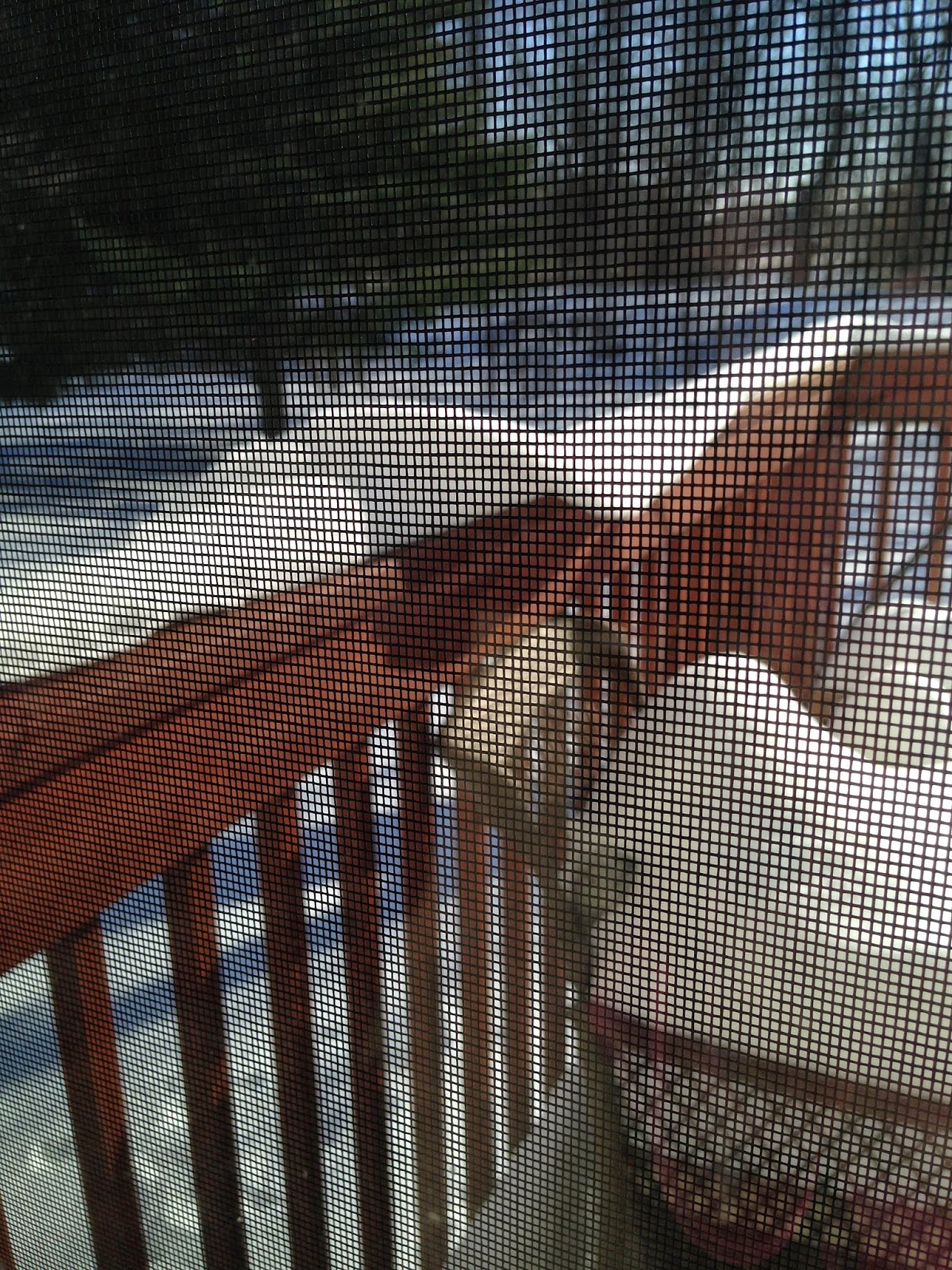 |
| from my frozen-shut patio door as the snow on the railing was slowly collapsing |
As young marrieds, after a couple of years' sojourn in Louisiana courtesy of the US Army, we moved back north. I remember the first snowfall we had that year - just before traveling away for Christmas. We were outside shoveling (really sliding the shovel along the driveway, it wasn't much), and I ended up wandering down the street, marveling at the sparkle and the lightness as if I were a child all over again.
2. In Summer:
I'm really looking forward visiting my favorite walking/hiking trails when it's warmer again. Nothing resets my spiritual batteries like time alone in nature. There are plenty of places to go and find what my soul craves, but my body is not a fan of sub-freezing temperatures.
3. Reindeers are Better than People:
I try to remember that hurt people hurt people. When someone seems difficult to love, I try to recognize that they are likely bearing a hurt that I do not know about.
4. Fixer Upper:
I've been doing daily spiritual readings from a new devotional I bought (morning and evening), although I've let it go (HA!) over the last few very busy days. There were a couple that just didn't click with me and after a couple of 'eh' days I drifted from the practice. Time to try again!
5. Let It Go:
I am trying to eat my way through the cabinets and freezer, making use of things I already have in the house as much as possible. I've been doing this for a couple of Lenten cycles now and it's been a great practice. It frees me up from excess and from the guilt of "Oh, I should use that..." as well as inspiring more creativity in the kitchen.
Into God's Time
For this hour, we step away
From clock time, and into God time.
Forgive our obsession with
concrete metrics. So often,
it is how we are measured.
But as an investment and
an experiment in your realm,
we will stop measuring
timeliness and productivity
just for this one hour-ish, though
it does not come naturally.
In this pocket of God-time and God-space,
carved out from the everyday,
our hearts say let your kingdom come.
Amen.
For the 2nd Sunday in Lent (Narrative Lectionary text Matthew 20:1-16)
From clock time, and into God time.
Forgive our obsession with
concrete metrics. So often,
it is how we are measured.
But as an investment and
an experiment in your realm,
we will stop measuring
timeliness and productivity
just for this one hour-ish, though
it does not come naturally.
In this pocket of God-time and God-space,
carved out from the everyday,
our hearts say let your kingdom come.
Amen.
For the 2nd Sunday in Lent (Narrative Lectionary text Matthew 20:1-16)
Subscribe to:
Posts (Atom)